
Social Anxiety Therapy In Ohio
Therapy for women and young adults who feel stuck in overthinking, self-consciousness, fear of judgment, or the pressure to always say and do the "right" thing

You Don't Have to Be Someone Else to Belong
Social anxiety can make even ordinary interactions feel like something you need to get right.
Maybe you're constantly thinking about how you're coming across, worrying that you've said the wrong thing, or wondering whether someone noticed how nervous you felt. You may carefully choose your words, rehearse what you're going to say, or hold back altogether because the possibility of being judged or rejected feels too uncomfortable.
Over time, it can become exhausting to constantly monitor yourself - Feeling as though you have to put on a mask in order to fit in. And perhaps even having different masks for different situations or groups of people.
You might leave a conversation and replay it for hours. You may wonder whether you sounded awkward, talked too much, said too little, or somehow gave someone the wrong impression. You may even find yourself avoiding social situations, opportunities, or relationships because it's easier than sitting with the uncertainty of how you'll be perceived.
The underlying struggle here?
You don't feel fully like yourself around other people.
Social anxiety has a way of convincing you that you need to be more interesting, more confident, less awkward, more agreeable, or somehow different in order to belong. But you don't have to become a different version of yourself to connect with other people.
You can learn to make room for discomfort, loosen the constant self-monitoring, and show up more fully as yourself—even when you don't know exactly how you'll be received.
That is the kind of work we can begin together in social anxiety therapy.

When You're Always Thinking About How You're Coming Across
Social anxiety isn't always obvious to the people around you. You may appear confident, capable, and comfortable socially while internally your mind is vigilant to every social nuance around you.
You might find yourself:
Rehearsing what you're going to say before speaking
Carefully monitoring your facial expressions, body language, or tone
Worrying that you'll say something embarrassing or "wrong"
Overthinking conversations while they're happening
Replaying interactions afterward and analyzing what you could have done differently
Assuming other people noticed your nervousness or mistakes
Comparing yourself to people who seem more confident or socially comfortable
Struggling to speak up, ask for what you need, or share your opinions
Avoiding social situations, gatherings, networking, dating, or other opportunities because they feel overwhelming
Saying yes when you'd rather say no because disappointing someone feels too uncomfortable
Feeling like you need to perform, impress, or be especially agreeable to be accepted
Sometimes, social anxiety looks less like avoiding people altogether and more like being present physically while your attention feels distant or fractured.
Instead of listening to the person in front of you, you're wondering:
Do I sound weird?
Did that come across the wrong way?
What are they thinking about me?
What should I say next?
Did I just embarrass myself?
This constant self-monitoring can make it difficult to feel present, connected, or genuinely yourself around others.
And the more you try to prevent awkwardness, rejection, or judgment, the more attention your brain learns to place on those possibilities.
Social anxiety isn't a sign that you're incapable of connecting with people. It may simply mean you've learned to protect yourself from the possibility of discomfort or rejection—and that pattern can be changed.
Understanding the Social Anxiety Cycle
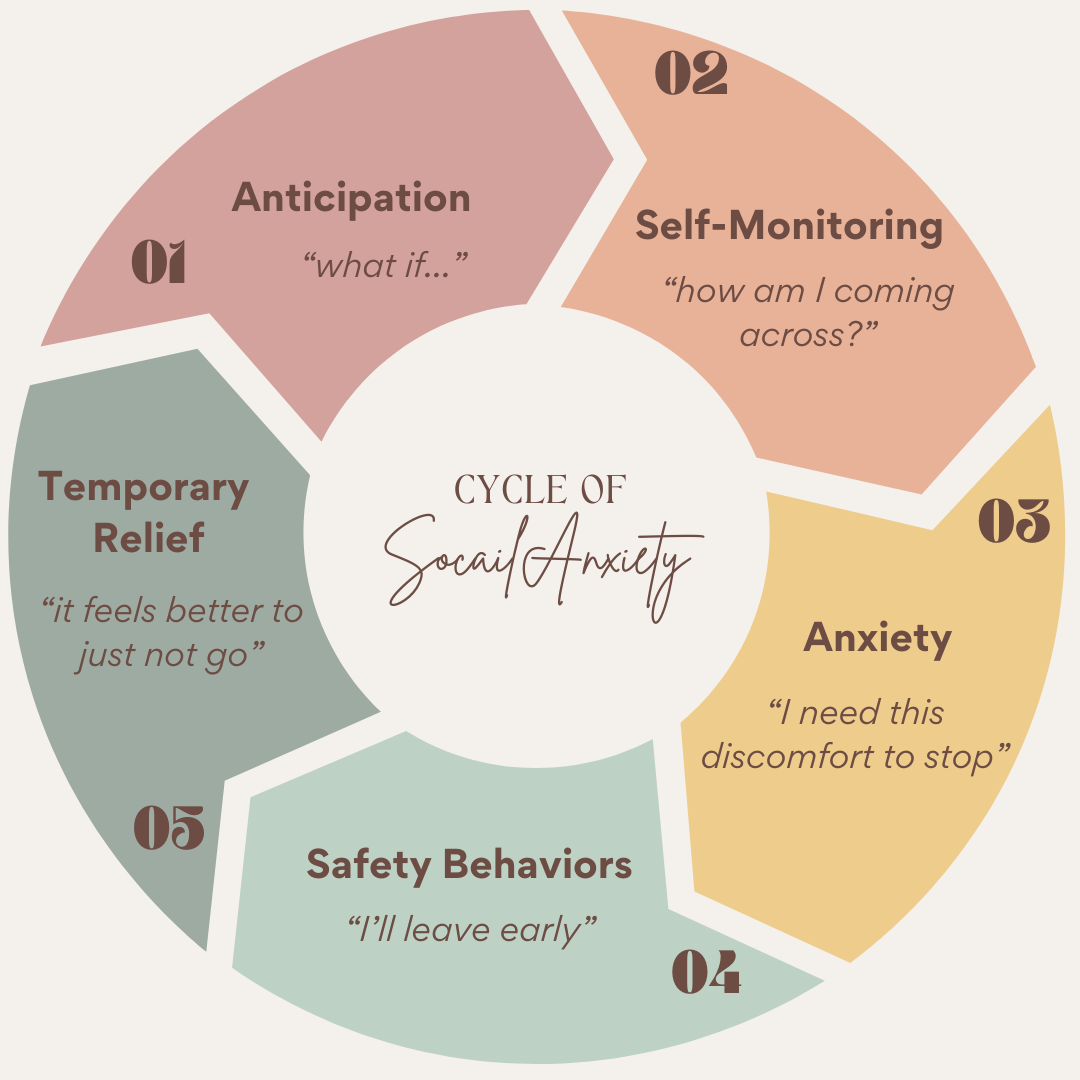
Social anxiety often begins before a social situation even happens.
You anticipate an interaction, imagine what could go wrong, and your brain starts preparing you to avoid embarrassment, rejection, or judgment. Once you're in the situation, your attention may turn inward as you monitor yourself and look for signs that something isn't going well.
Anticipation
Before a social situation, you might spend significant time imagining what could happen.
What if I don't know what to say?
What if they don't like me?
What if I embarrass myself?
What if everyone notices how nervous I am?
Your brain is trying to prepare you for a potential threat—but instead, you may arrive already feeling anxious and on guard.
Self-Monitoring
Once you're in the situation, your attention can shift away from the interaction and toward yourself.
You may monitor your voice, facial expressions, body language, appearance, or what you're saying. Instead of being fully present with the person in front of you, part of your attention is constantly evaluating: "How am I doing?"
Avoidance & Safety Behaviors
When anxiety rises, it's understandable to want to protect yourself from discomfort.
You might avoid certain situations altogether, stay quiet, leave early, rehearse conversations, over-prepare, look at your phone, avoid eye contact, or rely on alcohol or other strategies to feel more comfortable. These are sometimes called safety behaviors—things you do to prevent the feared outcome or make anxiety feel more manageable.
And they often work…at least temporarily.
Temporary Relief
Whenever you engage in avoidance or safety behaviors, your anxiety often drops temporarily, which teaches your brain that these behaviors are what keep you safe. Not only that, but avoidance also tells the brain that the situation is actually a real threat to you. While there may be temporary relief, this cycle actually leads to an increase in anxiety in the long run.
Another issue we experience when we engage in avoidance or safety behaviors is that we arent giving our brain the opportunity to learn that we CAN handle the situation. And it’s this opportunity that will lead to a decrease in anxiety long term and a return to feeling like yourself in those situations.
This is one of the reasons social anxiety therapy often involves Exposure and Response Prevention - gradually facing fears while reducing avoidance and safety behaviors and practicing new ways of responding to discomfort.
What Social Anxiety Can Look Like
Social anxiety can look different from person to person. You don't have to avoid every social situation or feel visibly anxious for social anxiety to be affecting your life.
Sometimes it looks like avoiding the things that make you uncomfortable. Other times, you may continue showing up—but spend the entire experience monitoring yourself, worrying about how you're being perceived, or replaying the interaction afterward.
You might notice:
-
Rehearsing conversations before they happen
Replaying interactions afterward
Analyzing what you said, how you said it, or how you were perceived
Worrying that you made a mistake or embarrassed yourself
-
Worrying about what others think of you
Feeling afraid of being disliked, criticized, or misunderstood
Assuming others are noticing your flaws or mistakes
Feeling like you need to be impressive, interesting, or agreeable to be accepted
-
Avoiding parties, meetings, networking, dating, or other social situations
Staying quiet even when you have something to say
Over-preparing or rehearsing what you'll say
Avoiding eye contact or leaving situations early
Looking to others for reassurance that you didn't do something wrong
-
Constantly monitoring your tone, facial expressions, appearance, or body language
Changing how you act depending on who you're around
Saying yes when you'd rather say no
Struggling to express your needs, opinions, or boundaries
Feeling disconnected from yourself because you're so focused on how you're coming across
You may recognize yourself in some of these experiences and not others. Social anxiety exists on a spectrum, and you don't need to check every box for therapy to be helpful.
If anxiety is making it harder to speak freely, form connections, pursue opportunities, or feel like yourself around other people, therapy can help you begin responding differently.
How I Treat Social Anxiety
Social anxiety treatment isn't about teaching you how to become the most confident person in the room—or making sure you never feel anxious, awkward, nervous, or self-conscious again. Instead, our work focuses on helping you change your relationship with anxiety so you can participate more fully in your life, even when discomfort is present.
My approach integrates Acceptance and Commitment Therapy (ACT), Cognitive Behavioral Therapy (CBT), mindfulness, and exposure-based strategies to help you understand the patterns that keep social anxiety going and begin responding to them differently.
Moving Beyond Avoidance
Avoiding social situations can provide immediate relief, but it can also teach your brain that those situations are something you need to be protected from. Together, we'll gradually identify the situations, thoughts, and experiences that social anxiety has taught you to avoid—and develop manageable opportunities to approach them differently. This may include practicing speaking up, expressing your needs, initiating conversations, attending social events, or allowing yourself to be seen without relying on the safety behaviors you've come to depend on.
The goal isn't to force yourself to feel confident first. It's to discover that you can take meaningful action even when anxiety comes along for the ride.
Changing Your Relationship With Anxiety
ACT helps us look beyond simply trying to make anxiety go away. We'll practice noticing anxious thoughts without automatically believing or responding to them, making room for uncomfortable feelings, and choosing your actions based on your values rather than fear of judgment or rejection.
Building a Life That Feels More Like Yours
Ultimately, social anxiety therapy isn't about becoming someone who never feels nervous around other people. It's about having more freedom to speak, connect, set boundaries, pursue opportunities, build relationships, and be yourself without constantly checking whether you're doing it "right." You don't have to wait until you feel completely confident to start participating in the life you want.
Confidence comes through experience and learning that you are capable of handling discomfort.


What Social Anxiety Therapy Can Help You Do
You don't need to become the most outgoing or confident person in the room to feel better around other people.
Social anxiety therapy can help you build the freedom to participate in your life without constantly monitoring, avoiding, or second-guessing yourself.
Through therapy, you can learn to:
Speak up and share your thoughts without needing to rehearse everything first.
Be more present in conversations instead of constantly monitoring how you're coming across.
Tolerate awkward moments and uncertainty without immediately assuming something went wrong.
Reduce avoidance and safety behaviors that have been keeping your world smaller.
Set boundaries and express your needs without feeling responsible for everyone's reaction.
Navigate relationships with greater authenticity rather than changing yourself to gain approval.
Attend social events, pursue opportunities, and try new things even when anxiety is present.
Spend less time replaying conversations and wondering what others might be thinking about you.
Build confidence through experience by discovering that you can handle discomfort, uncertainty, and the possibility of being misunderstood.
Reconnect with what matters to you so that your choices are guided more by your values than by fear.
The goal isn't to guarantee that you'll never feel nervous, awkward, or self-conscious again.
It's to help you stop organizing your life around avoiding those feelings.
You can learn to show up as yourself—even when anxiety comes along for the ride.